11 Prop Firms Drop Prop Firm Match After Cookie Stuffing Comes to Light
Minx, PropFirmTrend ·
11 Prop Firms Drop Prop Firm Match After Cookie Stuffing Comes to Light
In less than 24 hours, eleven prop firms dropped Prop Firm Match, one of the biggest prop firm comparison sites in the industry. Ten ended their affiliate relationships, and Topstep pulled its paid listing. The reason the firms gave: how Prop Firm Match was generating referrals.
Here's what happened, what each firm said, and what it means for you as a trader.
Disclosure: PropFirmTrend is also a prop firm comparison site and an affiliate of many of the firms below. That makes us a competitor of Prop Firm Match, so everything here sticks to what was recorded, tested and publicly posted.
How it started
For me, it started two days before anyone was talking about it.
On October 27, I took a payout from one of the prop firms I trade with. Right on the payout screen, the firm prompted me to leave a review on Prop Firm Match. The firm's team told me that prompt was meant for traders who signed up with Prop Firm Match's code. I have never used Prop Firm Match's code. I messaged the firm's CEO, and he had no idea why it was showing up either. The firm took the prompt down that same morning, and at the time I thought the firm itself was playing favorites with one affiliate.
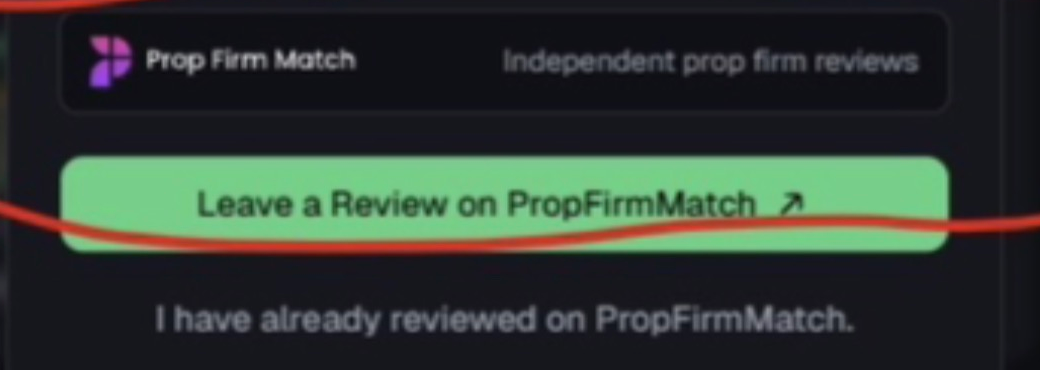
I was wrong about that. On October 29 at 3:33 PM, trader Kane (@traderkane) posted a screen recording showing that clicking an internal link on Prop Firm Match, like a firm's profile page or a copy-code button, did more than the visitor asked for. The page the visitor wanted opened in a new tab, while the original tab was quietly sent to the prop firm's website through Prop Firm Match's affiliate link. That's how a trader who never chose their code can end up tagged as their referral. If Kane hadn't posted that video, I would never have known why that prompt showed up on my payout.
That same afternoon I tested it myself in a private (incognito) browser window. I clicked Decline on Prop Firm Match's cookie banner, then clicked a firm's name in their comparison table. Their profile page opened in a new tab, and my original tab went to the firm through Prop Firm Match's referral link. I never clicked a link to the firm. When I later went to that firm on my own through Google and signed up, Prop Firm Match's discount code was already filled in at checkout.
The behavior is written into the site’s code, in a function that opens the clicked page in a new tab, sends the original tab to the affiliate link, and only fires once per firm, per browser, per day. That last part matters: anyone who tests it twice in the same browser sees nothing the second time. Prop Firm Match switched that code off on the evening of October 29, a few hours after Kane’s post. But the Internet Archive had already saved a copy of it on its own, days before any of this came out, so anyone can still check it:
https://web.archive.org/web/20261024013206/https://propfirmmatch.com/_next/static/chunks/409sez1i-ke0s.js
Over the next day, the firms ran their own tests and checked their own referral data. Then they started cutting ties.
What cookie stuffing is, and what it isn't
Cookie stuffing is when a site sets its referral on you without you choosing to click its referral link. It happens through hidden pages loading in the background, forced redirects, or, in this case, swapping your tab to an affiliate link when you clicked something else. Almost every affiliate program bans it, and it has led to federal wire fraud convictions in the past, most famously for two of eBay's top affiliates.
A code showing up at checkout is not cookie stuffing by itself. If you clicked a creator's referral link, a "Visit firm" button, or a link that says it goes to the firm, then the firm's site filling in that code is exactly how referral links are supposed to work. You chose that link. The code is just the firm remembering where you came from.
The difference comes down to one question: did you choose to go to the firm through that person's link? If yes, that's a normal referral. If you clicked something that said it stayed on the comparison site, or you declined cookies, and you still got tagged with their code, that's the problem.
The firms that cut ties
Prop Firm Match posted on October 29 at 10:14 PM CT that it was "looking into the questions raised" and would share a full statement within 24 hours. Over the next day, these firms announced they were done. Times are Central.
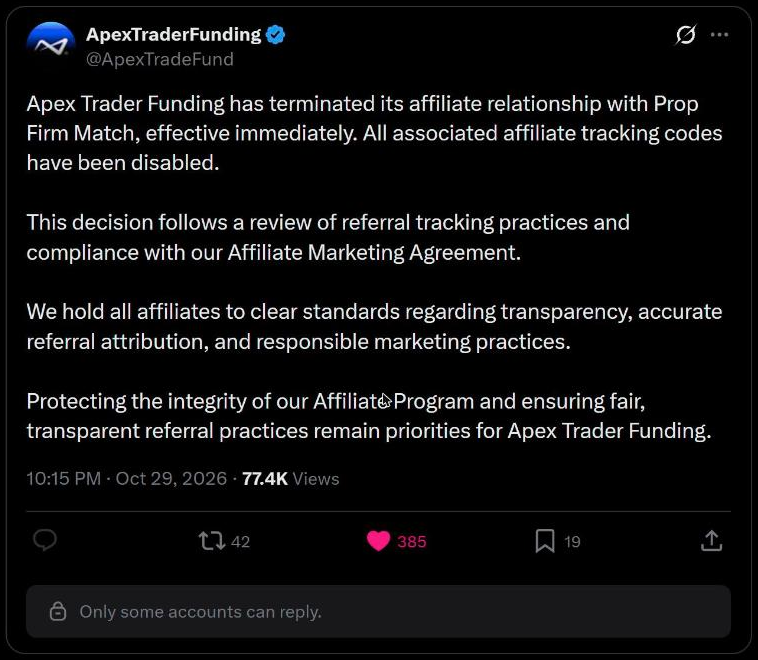
Apex Trader Funding (Oct 29, 10:15 PM) terminated its affiliate relationship with Prop Firm Match "effective immediately," disabled all associated tracking codes, and said the decision followed "a review of referral tracking practices and compliance with our Affiliate Marketing Agreement."
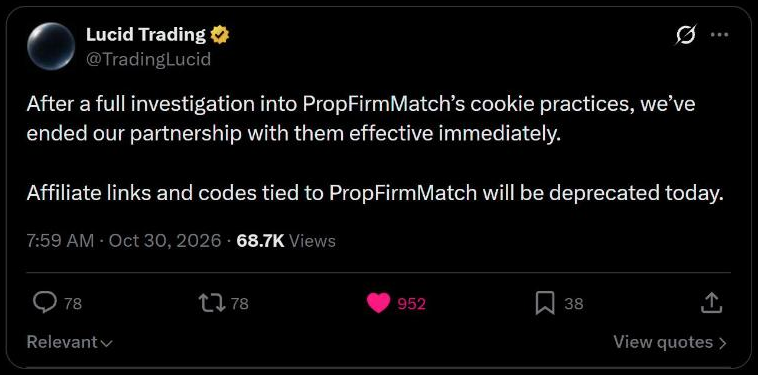
Lucid Trading (Oct 30, 7:59 AM) said that after "a full investigation into PropFirmMatch's cookie practices" it ended the partnership, with Prop Firm Match's links and codes deprecated the same day.
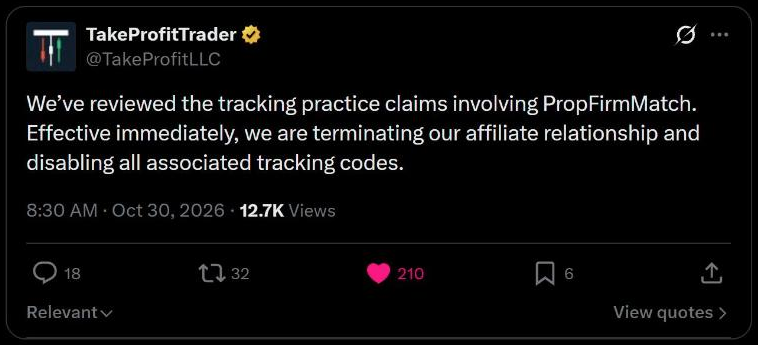
Take Profit Trader (8:30 AM) reviewed "the tracking practice claims involving PropFirmMatch" and terminated the affiliate relationship, disabling all associated tracking codes.
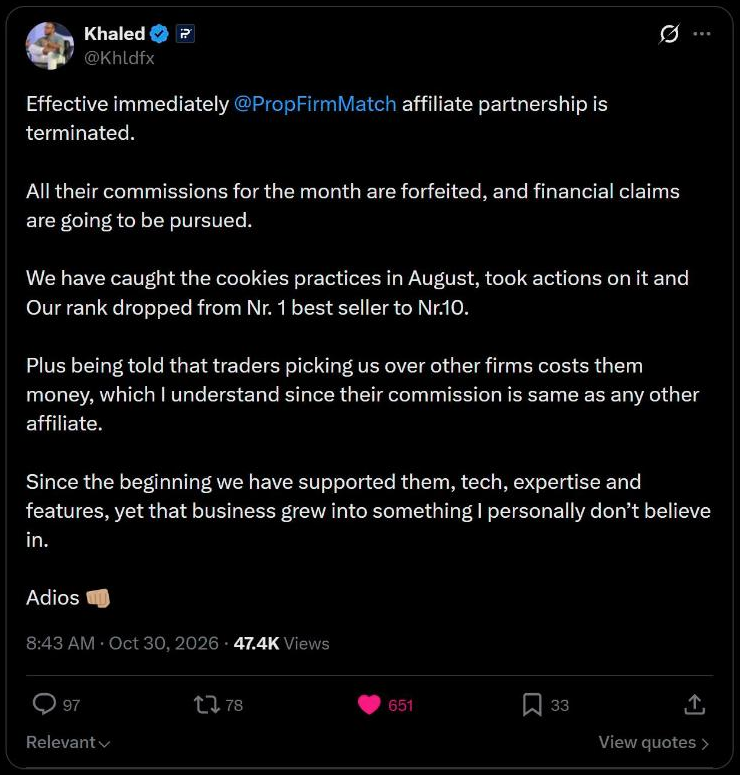
FundingPips (8:43 AM), through CEO Khaled, terminated the partnership and said Prop Firm Match's commissions for the month are forfeited and "financial claims are going to be pursued." He also said FundingPips had caught "the cookies practices in August."
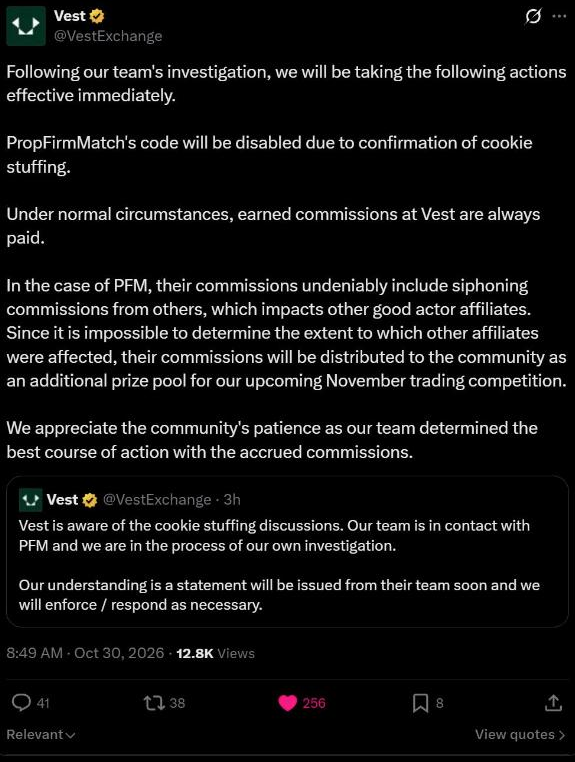
Vest (8:49 AM) disabled Prop Firm Match's code "due to confirmation of cookie stuffing." Vest said the commissions "undeniably include siphoning commissions from others," and because it can't tell which affiliates were affected, it will put those commissions into the prize pool for its November trading competition.
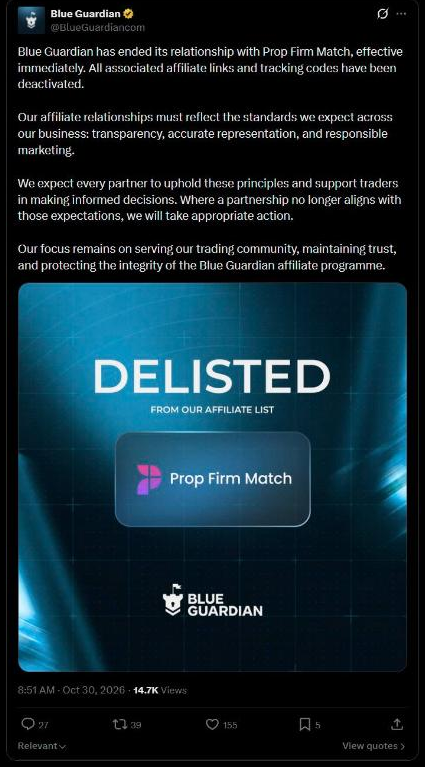
Blue Guardian (8:51 AM) ended its relationship and deactivated all associated affiliate links and tracking codes.
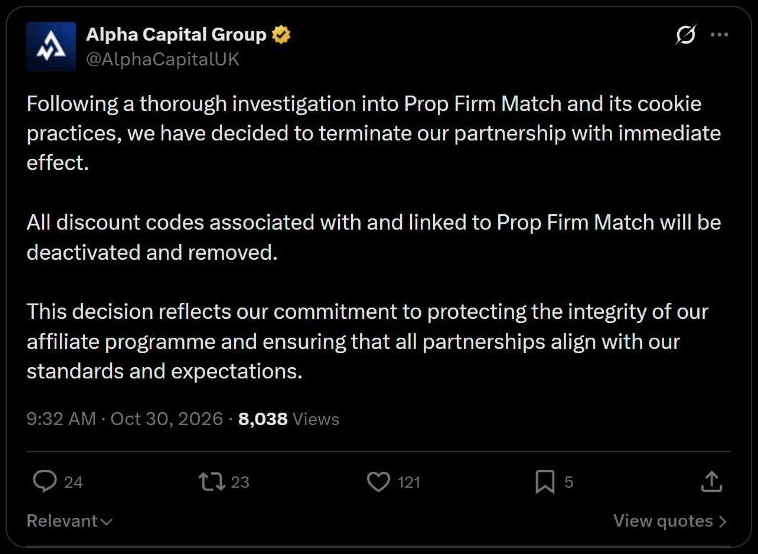
Alpha Capital Group (9:32 AM) terminated the partnership after "a thorough investigation into Prop Firm Match and its cookie practices" and is deactivating all linked discount codes.
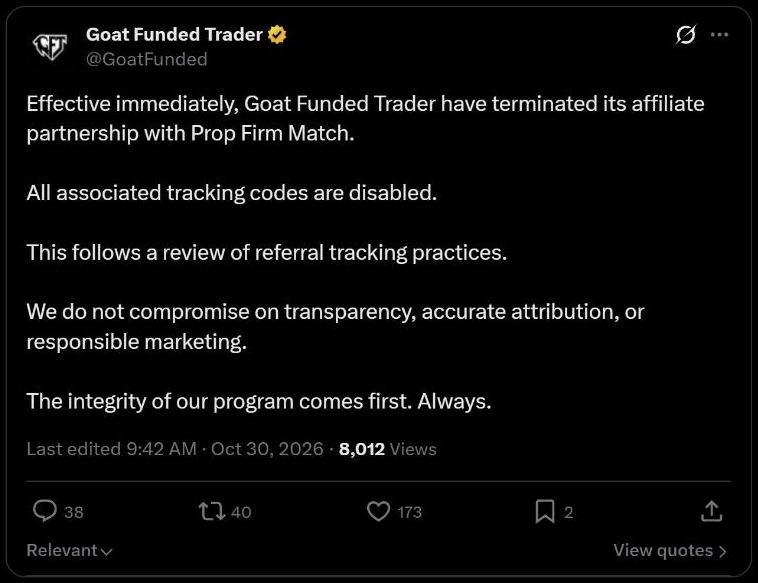
Goat Funded Trader (9:42 AM) terminated its affiliate partnership and disabled all tracking codes. Goat also said this month's Prop Firm Match commissions, $20,000, will go back to traders as a prize pool.
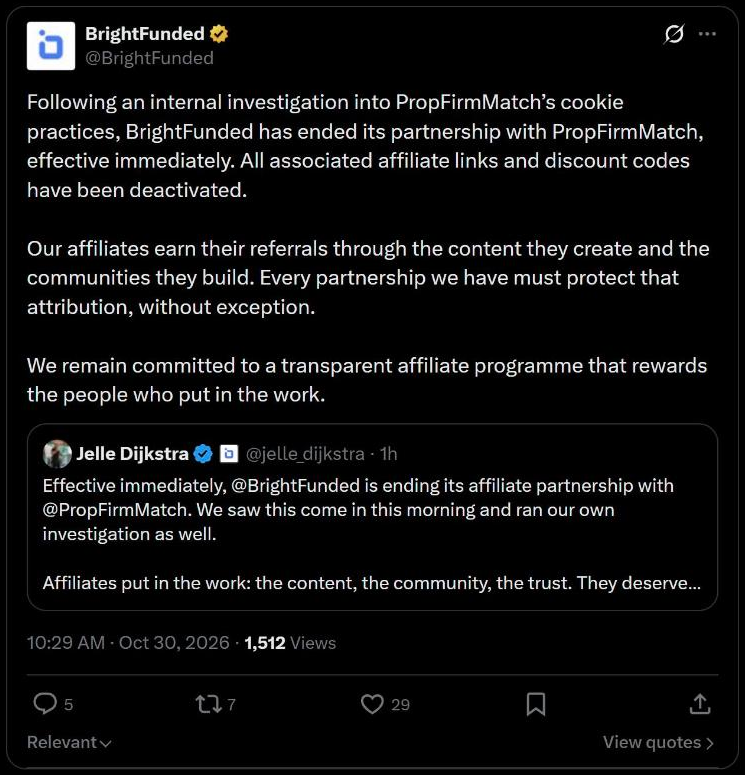
BrightFunded (10:29 AM) ended the partnership after its own internal investigation, saying its affiliates "earn their referrals through the content they create and the communities they build."
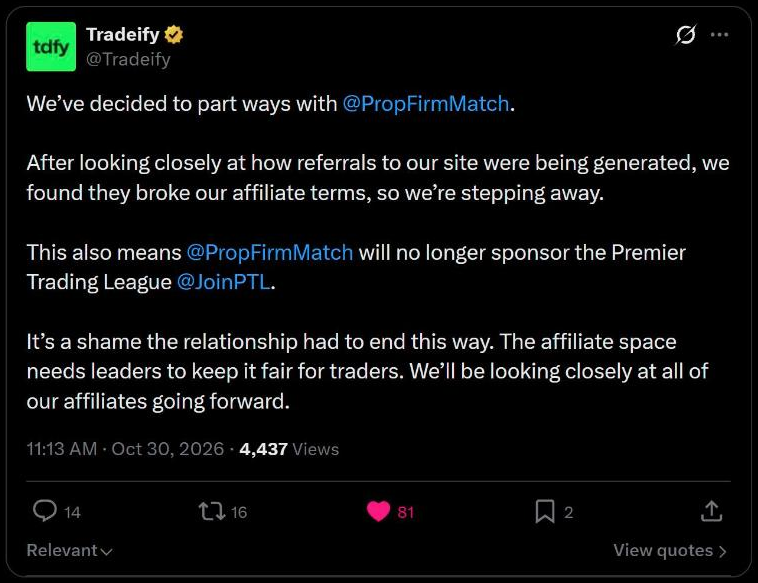
Tradeify (11:13 AM) said Prop Firm Match "broke our affiliate terms" and parted ways. It also means Prop Firm Match will no longer sponsor the Premier Trading League.
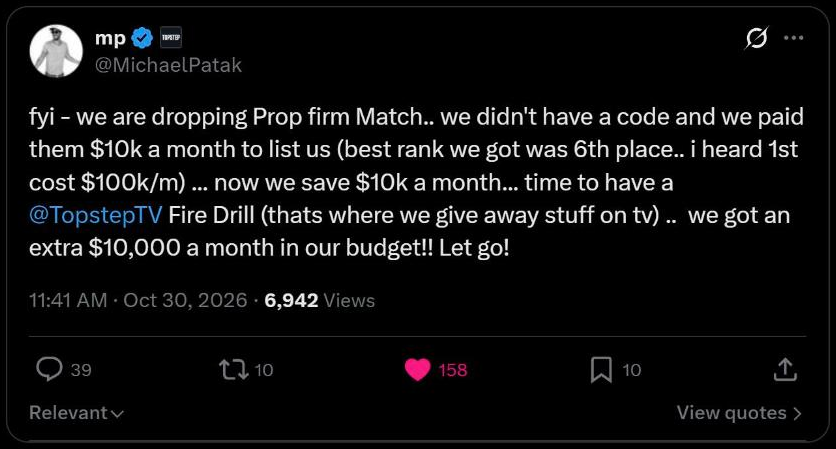
Topstep (11:41 AM) never had an affiliate code with Prop Firm Match, but founder Michael Patak said Topstep is dropping it anyway. He said Topstep paid Prop Firm Match $10,000 a month to be listed, that the best rank it ever got was 6th place, and that he'd heard the top spot cost $100,000 a month. That $10,000 a month now goes to giveaways on TopstepTV instead.
As of this writing, Prop Firm Match had not posted its full statement.
Why this matters to traders
Using a code is your choice. If you pick a creator's or a site's code because they helped you, that's how affiliate marketing is supposed to work, and it's how good educators get paid for the work they put in.
Cookie stuffing takes that choice away. You click to read about a firm, and someone else gets credited as the person who sent you there. The creator who actually taught you, answered your questions or showed you the firm gets nothing. Over time, that rewards whoever games the tracking instead of whoever helps traders most.
It also costs the prop firms real money. When a trader gets sent through an affiliate link they never clicked, the firm pays a commission for a referral that never happened. That's money taken straight from the firm, and in the end that cost comes out of the discounts, payouts and promotions that firm could have given traders.
Some people argue a comparison site deserves credit because traders use it for research. But visiting a website doesn't mean it helped you decide. And if a site's research really did help, there's already an honest way to get paid for it: a clear "Visit firm" button the trader chooses to click. That's how every honest affiliate earns.
It also matters when a site that ranks and reviews firms is the one doing it. Traders lean on comparison sites to be straight with them.
What you can do
Check the discount code at checkout before you pay. If it isn't the code you meant to use, change it.
If you've visited Prop Firm Match recently, clear your cookies or site data for the prop firm's website before you buy, so an old referral doesn't follow you.
Use the code of the person or site that actually helped you. That's the whole system working the way it should.
And if you see something like this anywhere, including on our site, say something. That's how this one came to light.
PropFirmTrend will keep this page updated as more firms respond and when Prop Firm Match releases its statement.